MS Nurse PROfessional is building a stronger voice for specialised multiple sclerosis nursing across Europe. We advocate for health systems that enable nurses to deliver high-quality, coordinated and efficient care for people living with MS.
Our advocacy is grounded in practice, shaped by nurses and people living with MS, and translated into concrete policy recommendations for decision-makers at European and national level.
📅 Date: Tuesday, 1 December 2026
🕓 Time: 16:00–18:00
📍 Location: European Parliament, Brussels, room to be confirmed
🎤 Hosted by: MEP Billy Kelleher, Substitute Member of the SANT Committee
MS Nurse PRO organises a policy event at the European Parliament on Tuesday, 1 December 2026, from 16:00 to 18:00, hosted by MEP Billy Kelleher, Substitute Member of the SANT Committee.
Across Europe, health systems are facing growing workforce pressures, more complex care needs and increasing demand for integrated, patient-centred care. In multiple sclerosis, specialist nurses play a key role in keeping care pathways coherent, yet they often face excessive caseloads, administrative burden, limited recognition and insufficient authority within multidisciplinary teams.
This policy meeting will bring together EU institutions, Member States and stakeholders to discuss how advanced practice and specialised nursing can be supported through recognition, training, digital tools, multidisciplinary care models and targeted EU-funded pilots.
The discussion will focus on reducing administrative burden, strengthening advanced nursing roles, improving access to specialist training and multidisciplinary care, and identifying EU and national policy actions that can support more sustainable healthcare systems.
More information soon available

Across Europe, people living with multiple sclerosis do not always have access to the coordinated, multidisciplinary support they need. At the same time, many nurses work under growing pressure, with too much administration, uneven access to specialised training, and limited recognition of their role within the care pathway.
This is not only a workforce issue. It is a quality-of-care issue.
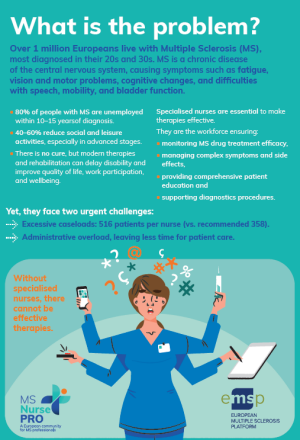
Over 1 million Europeans live with Multiple Sclerosis (MS), most diagnosed in their 20s and 30s. MS is a chronic disease of the central nervous system, causing symptoms such as fatigue, vision and motor problems, cognitive changes, and difficulties with speech, mobility, and bladder function.
Specialised nurses are essential to making this care work in practice. They help monitor treatment efficacy, manage complex symptoms and side effects, provide patient education, and support diagnostic procedures. When nurses are overstretched, key clinical and psychosocial tasks risk being delayed or left undone.
That is why MS Nurse PRO is advocating for practical, evidence-based changes that can improve care for people with MS and make nurses’ work more sustainable.

In 2024, MS Nurse PROfessional launched a multinational survey to better understand the workload management of nurses caring for people with MS in Europe.
The survey included 108 nurses from 15 countries and highlighted a clear need for systemic change:
These findings reinforce what nurses have long been saying: better workload management is essential to safeguarding high-quality MS care.
In response, the nursing community identified clear priorities: more specialised nurses, better access to psychological support and allied healthcare professionals, stronger multidisciplinary care, less administrative burden, and greater referral and prescribing authority for appropriately trained nurses.
You can explore the evidence in more detail through our supporting materials:

1. Recognise advanced and specialist neuroscience nurses as essential healthcare professionals
Recognise advanced and specialist neuroscience nurses as essential healthcare professionals who improve access, coordinate multidisciplinary care and reduce pressure on overstretched neurological services. Europe needs both more nurses and a better use of existing nursing expertise.
2. Ensure access to multidisciplinary care for people living with MS
People living with Multiple Sclerosis should have timely access to multidisciplinary care, including psychologists, physiotherapists, occupational therapists and social workers. Specialist and advanced MS nurses should play a central role in identifying patient needs, coordinating access to these professionals and supporting continuity of care.
3. Create an EU-supported Advanced Practice Nursing Model for Chronic Neurological Disease
Create an EU-supported Advanced Practice Nursing Model for Chronic Neurological Disease, starting with multiple sclerosis as a pilot condition[GU1] . This should define common descriptors of scope, competencies, digital skills, multidisciplinary team coordination responsibilities, patient-facing outcomes and the role of advanced nurses in chronic neurological care pathways.
4. Fund pilots to reduce administrative burden for nurses and care teams
EU and national funding programmes should support pilots that map current administrative work, test digital and team-based solutions, and reduce avoidable administrative burden for nurses and care teams. MS Nurse PRO could propose a pilot aiming to reduce avoidable administrative burden by 25% by 2030, while improving time for patient-facing care.
5. Use EHDS implementation to reduce administrative burden and improve care coordination
Use the implementation of the European Health Data Space and national electronic patient health records to reduce administrative burden and improve care coordination. Nurses and patients should be involved in the design of digital systems, and implementation should measure usability, workload impact, care coordination and reductions in avoidable administrative tasks.
6. Assess EU and Member State options for recognition of advanced practice nursing
Launch a formal mapping and feasibility assessment of how advanced practice nursing is recognised across Europe, including whether and how Directive 2005/36/EC on professional qualifications could better support advanced nursing roles. Member States and regions should also assess how nurse independent prescribing and referral qualifications can be made available where appropriate and safe.
7. Make advanced nursing and workforce role redesign part of the brain health agenda
A European brain health plan or roadmap should include care pathways, workforce roles, advanced nursing, multidisciplinary care, training and patient support, alongside research and innovation. The Irish and future Council Presidencies should place health workforce role redesign on the political agenda through Council discussions, Presidency events, written briefings or Council conclusions.
Our advocacy is built on four pillars:
We are gathering evidence on workload management, nursing roles, training pathways, and differences across healthcare systems. Our 2024 survey on nurses caring for people with MS provides a strong evidence base for reform and has helped identify where workload pressure is affecting the quality and coordination of care.
We are collecting testimonials from nurses and people living with MS to show what good care looks like in practice — and where systems still fall short.
Following the survey, we presented our findings at ECTRIMS2024 and again at ECTRIMS2025, helping raise awareness of the workload challenges facing nurses caring for people with MS and of the solutions nurses are calling for.
We bring this evidence into European and national policy discussions through targeted stakeholder meetings and advocacy events. In February 2026, we held an online policy meeting with Member of the European Parliament Kateřina Konečná (CZ), Executive Director of the European Specialist Nurses Organisation Ber Oomen, MS Consultant Nurse Noreen Barker (UK), University College London Hospitals NHS Foundation Trust, and national clinical experts, and are preparing a live policy event at the European Parliament to discuss how smarter workload strategies for MS nurses can safeguard high-quality care in European healthcare systems.
Are you an MS nurse or a nurse caring for people with MS?
We want to hear about your professional experience.
Do you:


Are you a person living with MS?
We want to hear about your experience of care.
Have you had access to:
We advocate for value-based nursing in multiple sclerosis, where digital tools and intelligent systems meaningfully reduce administrative burden and enable nurses to practise at the top of their expertise.
Within a well-structured multidisciplinary care team, MS specialised nurses take a leading role in coordinating care and focus their clinical work on high-value, specialised nursing activities.
Tasks that are better addressed through other professional expertise are appropriately delegated to trained colleagues, ensuring that skills across the care team are applied where they add the greatest value and helping to safeguard both care quality and workforce sustainability.