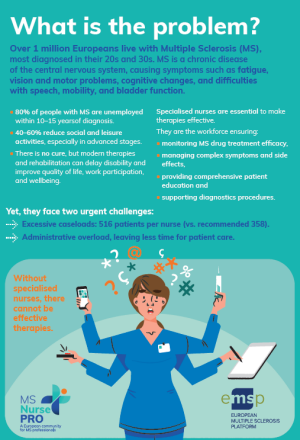
Over 1 million Europeans live with Multiple Sclerosis (MS), most diagnosed in their 20s and 30s. MS is a chronic disease of the central nervous system, causing symptoms such as fatigue, vision and motor problems, cognitive changes, and difficulties with speech, mobility, and bladder function.
Specialised nurses are essential to make therapies effective. They are the workforce ensuring:
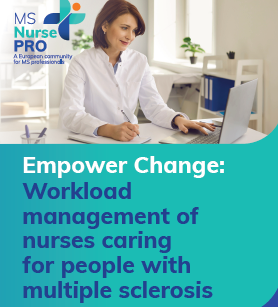
In 2024, MS Nurse PROfessional launched a survey to collect insights on the workload management of nurses caring for people with MS*.
Find the abstract below:
BACKGROUND: MS Nurse PROfessional is an educational program designed to support nurses caring for people with multiple sclerosis (PwMS), serving as a platform to increase knowledge and share expertise. As part of advocating to improve working conditions, MS Nurse PROfessional conducted a survey to describe workload practices of nurses in Europe caring for PwMS, and survey their opinions on potential solutions to address tasks currently left undone.
METHODS: The online survey included questions around demographics, professional background, and workload management. It was made available in ten languages to MS Nurse PROfessional community members and other MS nurses.
RESULTS: 108 nurses from 15 countries were included. 74% (n=78) of respondents have a caseload >300 PwMS per year, which equates to a mean average caseload of 516 PwMS per MS nurse. The majority of nurses (69%) spend between 30 minutes and 3 hours on each consultation, including follow-up tasks. Nurses dedicate most time to treatment and symptom management. Work left undone due to time constraints includes clinical trials, social benefits advice, team consulting, psychological interventions/support, and paperwork completion. Over half of nurses surveyed have limited administrative support. Findings indicate that the nursing community is advocating for an increase in the number of nurse colleagues, increased access to psychological support for the PwMS, the ability for nurses to refer to a multidisciplinary care team and the ability to independently prescribe certain medications.
CONCLUSIONS: This survey of nurses caring for PwMS provides useful insights into current workload practices and awareness of their improved management.
In short, the findings reveal alarming trends:
*Find additional information here.

As part of advocating for improved conditions, we presented our study in the ECTRIMS 2024 e-poster session.
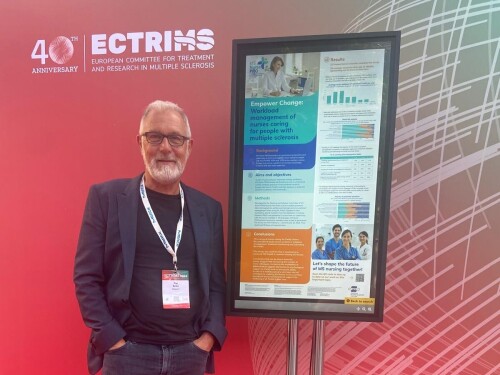
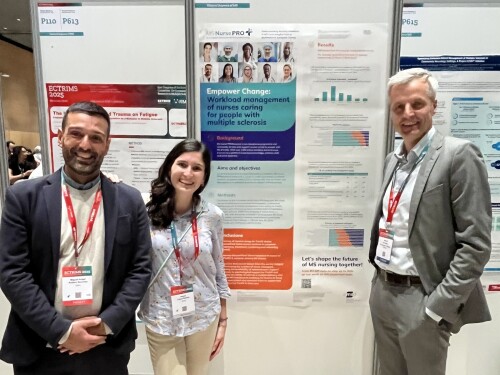
This year, we were able to display our poster during the ECTRIMS 2025 printed poster session!
Building on this momentum, we recently held an online policy meeting featuring Member of European Parliament Katrina Konecna (CZ), substitute to the Committee on Public Health, Ber Oomen, Executive Director of the European Specialist Nurses Organisation, and Noreen Barker (UK), MS Consultant Nurse, and are preparing the next key session, a live meeting at the European Parliament. The objective of these sessions is to bring together European and national politicians, policymakers, and healthcare stakeholders to share with them our survey findings, present our evidence-based policy recommendations, and discuss how smarter workload strategies for (multiple sclerosis) nurses can safeguard qualitative care in European healthcare systems.

1. More specialised nurses caring for PwMS (incl. digital skills)
2. Access to psychologist, physiotherapist, occupational therapist, social worker for PwMS
3. Access to and a central role for nurses within the multi-disciplinary team (MDT) and ability to independently refer
4. Less and more efficient paperwork & streamlined administration utilising digital technology
5. Nurse independent prescriber qualification is available*
* We acknowledge that in many healthcare systems, this requires an evolution of the legal and training framework.
We have launched a call for contributions, inviting MS nurse and patient to share their testimonials to support us in advancing our recommendations.

We want to confront the systemic challenges faced in multiple sclerosis (MS) care and to present concrete recommendations that can both improve patient outcomes and enhance nurses’ working conditions.
Join us in shaping that future!